Inside China’s Toy Industry | Episode 08 | Holly Wonder Toys
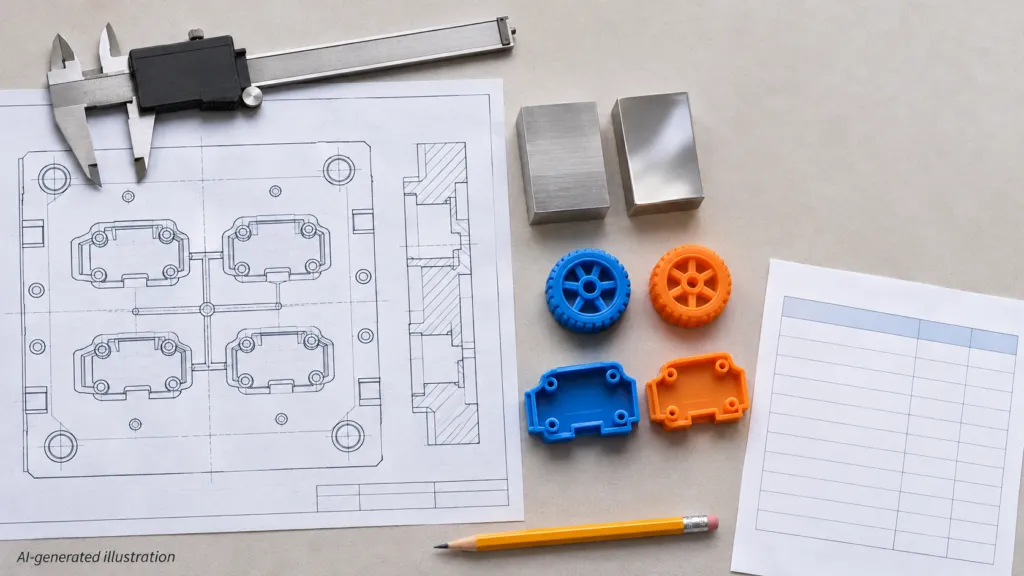
How much does a toy mold cost? For a plastic injection-molded toy, there is no useful universal price without an agreed design and production brief. The quotation depends on the parts, tooling specification, output requirements, and work included before production approval.
For importers, wholesalers, and toy brands, the first step is to separate the one-time tooling investment from the recurring cost of each finished toy. Then compare quotations against the same technical and commercial scope.
One-time tooling investment versus per-unit product cost
The tooling quotation may cover design review, mold engineering, the mold base, core and cavity manufacture, purchased components, fitting, finishing, and agreed trials. Ask for an itemized scope: extra trials, later design changes, replacement inserts, shipping, and taxes may be separate.
The recurring product price can include resin, colorant, machine time, labor, scrap, assembly, decoration, packaging, and quality checks. Testing, inspection, freight, and duties may be additional. Paying for the mold does not remove these recurring costs.
A toy with several plastic components may require several molds. Confirm whether the quote covers one component, a complete set of tools, or the entire finished toy.
What drives a plastic toy mold quotation?
Cavity count and realistic production volume
A single-cavity mold makes one part per molding cycle, or shot. A multi-cavity mold makes several. More cavities can increase output and reduce processing cost per acceptable part, but require more tooling work and careful filling balance. Compare demand, machine compatibility, cycle time, and quality across every cavity.
A family mold produces different components in one tool. Different filling and cooling needs can complicate the arrangement, so it should be evaluated rather than assumed to be the cheapest solution.
Tooling materials and expected life
Request the core and cavity material specification, relevant heat treatment, and wear-component details. Steel grade alone does not establish performance: construction, resin, operating conditions, and maintenance also matter.
Define expected mold life in shots under stated conditions, including maintenance obligations and wear exclusions. Shots are production cycles, not finished-toy quantities. Account for cavity count, scrap, and the number of components needed per toy.
Geometry and structural complexity
Large or deep parts, tight tolerances, thin features, and undercuts can increase engineering and machining work. Slides, lifters, inserts, and complex ejection add mechanisms that may also need maintenance. Request a design-for-manufacture review before approving tooling.
Confirm the runner and gate arrangement, cooling approach, and permitted gate or ejector marks. A practical design adjustment may reduce cost more effectively than negotiating an unchanged complex tool.
Surface finish and cosmetic expectations
Gloss, texture, transparent surfaces, and visible parting lines require clear acceptance references. Identify which surfaces need which finish. Texture can affect draft and release, while demanding cosmetics can add tool-finishing work. Painting and printing on the toy are separate operations unless explicitly included.
Define trial molding and modification costs
Ask how many trial rounds are included, which resin and color will be used, what samples will be supplied, and which dimensional or appearance reports are included.
Separate corrections needed to meet the approved specification from buyer-requested design changes after approval. Record who pays, how changes are authorized, and whether another trial or revised schedule is required.
Before mass production, agree acceptance criteria for dimensions, appearance, fit, and function. Review representative parts from every cavity and, where appropriate, evidence from a sustained run at intended production settings. One attractive sample does not establish consistent output.
Why a higher quotation does not automatically mean better quality
Different totals may reflect different materials, mechanisms, finishing, trial coverage, or support. A lower quote may omit required work; a higher quote may include features your project does not need. Ask suppliers to explain the difference.
Assess the tooling specification, process controls, maintenance arrangements, and accepted production results. Mold price alone proves neither quality nor finished-toy compliance.
Agree mold ownership and maintenance in writing
Payment, legal ownership, physical custody, and transfer rights are different matters. Before ordering, agree:
- Who owns the mold and design data, and when ownership transfers.
- Where it will be stored and whether use for other customers is prohibited.
- How the tool is identified and what drawings or records will be provided.
- Release conditions, outstanding payments, transfer costs, and machine compatibility.
- Responsibility for cleaning, rust prevention, maintenance, repairs, and wear parts.
Also clarify storage after inactivity and what happens if the supplier closes or the tool becomes unusable. Have transaction-specific contract terms reviewed as appropriate.
Understand tooling amortization
For sourcing comparisons, tooling allocation per acceptable part can be calculated as:
Agreed tooling investment ÷ planned acceptable-part quantity
This is a planning allocation, not a supplier quotation. Higher planned volume reduces the allocation only if the volume is actually ordered and accepted. Keep the recurring part price separate, and account for all relevant tools and component quantities when calculating finished-toy cost.
If tooling is recovered through the unit price, agree the recovery amount, volume assumption, and end point. Compare upfront and embedded-tooling quotations on the same basis, and avoid paying twice.
What to send with a toy mold quotation request
- Current drawings or CAD files, revision number, and component quantities.
- Target resin, color, finish, and critical dimensions.
- Expected annual demand, initial order size, and launch timing.
- Destination market and applicable product requirements.
- Trial samples, reports, and acceptance criteria required.
- Ownership, storage, maintenance, and transfer requirements.
Request a separate recurring product quotation with clear volume, packaging, and delivery assumptions. Compare exclusions and agree milestones for design approval, trial review, correction, final acceptance, and payment.
Frequently asked questions
Can a supplier quote a mold from a photograph?
A photograph can start the discussion, but a reliable quotation normally needs geometry, dimensions, resin, finish, output, and quality requirements. Treat an early estimate as provisional.
Will more cavities always make a toy cheaper?
No. Additional tooling investment, machine size, cycle time, demand, and acceptable-part yield affect the result. Compare total cost over realistic production volume.
If I pay a mold fee, do I own the mold?
Do not assume so. Ownership, permitted use, custody, release rights, documentation, and transfer costs should be agreed in writing.
Are later modifications included?
Only when the agreement includes them. Define correction obligations separately from buyer-driven design changes and additional trial work.
Does an approved mold prove toy safety compliance?
No. Tooling acceptance and finished-toy safety evaluation serve different purposes. Applicable market requirements and testing need their own review.
Discuss your toy tooling brief with Holly Wonder Toys
Send your drawings, target resin, estimated order volume, destination market, and launch timing to hollywang@hollysourcing.com.
Visit Holly Wonder Toys to start the conversation. Ask for a clearly scoped tooling discussion and a separate recurring product-cost breakdown. A final quotation requires review of the actual project.
Further technical reading
- Xometry: Understanding Injection Molding Cost for Manufacturers
- Protolabs: Multi-Cavity and Family Injection Molding
- Protolabs: Estimating Mold Cost and Eliminating Cost Drivers
General engineering references reviewed November 9, 2026. This article does not provide a binding mold quotation or verify any particular factory, certification, or tooling-life guarantee.
Related toy categories
Explore the wholesale ranges that match this guide:
- Kid Toys — the full wholesale kids toy range
- Puzzles & Building Blocks — puzzles and building block sets
- Role-play Toys — role-play and pretend-play sets