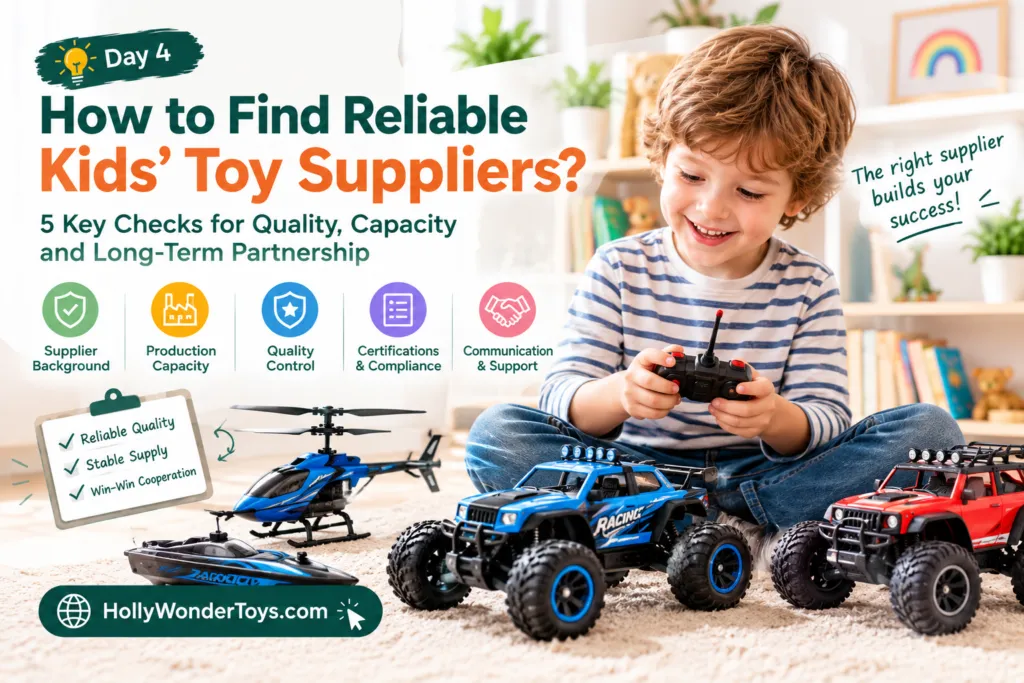
DAY 4 | KIDS’ TOY SOURCING GUIDE
How to Find Reliable Kids’ Toy Suppliers: 5 Key Checks for Buyers
Finding a reliable kids’ toy supplier is an important step for importers,
distributors, wholesalers, and retailers planning a new product collection.
The right supplier should offer more than attractive products. Buyers also
need to evaluate production capacity, quality control, compliance
documentation, and communication.
Whether you are sourcing from China or Southeast Asia, a structured
supplier evaluation process can help you compare potential partners,
identify risks, and make more informed purchasing decisions.
In this guide, we explain five key areas to check before choosing a
kids’ toy supplier.
1. Check the Supplier’s Company Background 🏢
Before discussing prices or placing an order, learn more about the
company behind the products. Understanding a supplier’s business
background can help you assess whether its experience and capabilities
match your sourcing requirements.
What Should Buyers Check?
- Company history and experience in the toy industry
- Main product categories and specialization
- Factory location and business operations
- Experience exporting to your target markets
- Previous experience with similar products
- OEM, ODM, and private-label capabilities
- Available company and factory information
If you are sourcing educational toys, role-play toys, wooden toys,
or electronic toys, look for suppliers with relevant product experience.
A supplier specializing in your category may better understand its
materials, components, production processes, and documentation needs.
You can also ask for a company profile, product catalog, factory
introduction, and relevant customer or export experience.
Buyer’s tip: Make sure the supplier’s actual business
capabilities match the information presented in its company profile.
2. Evaluate Production Capacity and Supply Stability 🏭
A supplier may offer an attractive product, but buyers also need to
know whether it can meet the required order quantity and delivery
schedule. Production capacity is particularly important when planning
seasonal launches, promotional campaigns, or repeat orders.
Key Questions About Production Capacity
- What is the factory’s normal production capacity?
- What is the MOQ for each product or customization option?
- What is the estimated production lead time?
- Can the supplier handle larger or repeat orders?
- Are important components and materials readily available?
- How does the supplier manage peak-season orders?
- Can the supplier provide updates if production is delayed?
Buyers should distinguish between a supplier’s stated maximum capacity
and the production capacity actually available for their order.
Confirm the expected production schedule, especially during busy
sourcing seasons.
For customized products, ask whether changes to colors, packaging,
materials, or functions will affect the MOQ and lead time.
Buyer’s tip: Confirm production schedules and order
requirements in writing before placing a purchase order.
3. Review Quality Control Procedures 🔍
Consistent product quality is essential when sourcing kids’ toys.
Buyers should understand how a supplier checks products during
production and before shipment, rather than relying only on the
appearance of a sample.
Quality Control Questions to Ask
- Does the supplier have documented quality-control procedures?
- Are incoming materials and components inspected?
- Are products checked during production?
- Is a final inspection conducted before shipment?
- How are defective products identified and handled?
- Can the supplier provide inspection reports when available?
- How are product specifications and approved samples maintained?
For toys with moving parts, electronic functions, lights, or sounds,
buyers should pay attention to the relevant functions and components.
For wooden toys, check the finish, edges, assembly, and consistency
of the materials.
Request product samples and compare them with the final production
specifications. For larger orders, consider arranging an independent
inspection based on your product and purchasing requirements.
Buyer’s tip: Agree on product specifications and
acceptable quality requirements before mass production begins.
4. Verify Certifications and Compliance Documentation 📋
Toy safety requirements vary by destination market, product type,
age grading, and other product characteristics. Buyers should confirm
which requirements apply to the specific toys they intend to import.
Do not assume that one certificate or test report automatically covers
every product or every market. Check that the documents are relevant
to the product, model, materials, and intended destination.
What Compliance Information Should Buyers Request?
- Applicable product safety standards for the destination market
- Relevant test reports and supporting documentation
- Product model and identification details
- Materials and component information
- Age grading and required warning information
- Battery or electrical documentation, where applicable
- Packaging and labeling information
For example, buyers sourcing toys for the United States or European
Union should identify the applicable requirements for each product
before ordering. Requirements may differ between ordinary toys,
electronic toys, toys for younger children, and other product types.
Ask the supplier to provide available documents for review, and
consult the appropriate testing or compliance professionals when
necessary.
Buyer’s tip: Check documentation before confirming
an order, and verify that it corresponds to the exact product being
sourced.
5. Assess Communication and Customer Support 🤝
Clear communication helps buyers and suppliers coordinate product
development, sampling, production, inspections, and shipment.
It is especially important when sourcing internationally across
different time zones and languages.
Signs of Effective Supplier Communication
- Responds clearly to product and quotation inquiries
- Provides complete and understandable product specifications
- Confirms prices, MOQs, and lead times in writing
- Communicates changes to materials or product details
- Provides timely production updates
- Explains problems and proposed solutions clearly
- Can coordinate samples, packaging, and shipment details
During the quotation and sampling stages, observe how the supplier
handles questions and feedback. A clear process for confirming
product details can help reduce misunderstandings later.
Buyers should also confirm who will be responsible for communication
during product development, production, quality checks, and shipment.
Buyer’s tip: Keep important specifications, approvals,
changes, and delivery commitments documented in writing.
Supplier Evaluation Checklist for Toy Buyers ✅
Use this checklist when comparing potential kids’ toy suppliers.
It can help your purchasing team organize questions and identify
information that still needs to be confirmed.
Company Background
- Company profile and product specialization reviewed
- Relevant toy industry experience checked
- Factory or business capabilities understood
Production Capacity
- MOQ and order quantity confirmed
- Production lead time discussed
- Repeat-order and peak-season capacity reviewed
Quality Control
- Product samples evaluated
- Quality-control process discussed
- Product specifications and inspection requirements agreed
Certifications and Compliance
- Destination-market requirements identified
- Relevant documents requested and reviewed
- Product labeling and warnings checked
Communication and Support
- Quotation and product details clearly documented
- Production update process confirmed
- Contact person and issue-handling process identified
Common Mistakes to Avoid When Choosing a Toy Supplier ⚠️
Choosing Only by Price
A low quotation does not provide a complete picture of sourcing costs.
Compare specifications, packaging, quality requirements, MOQ, shipping
arrangements, and other costs before making a purchasing decision.
Relying Only on Product Photos
Product photos cannot confirm all product details or production quality.
Request samples and review the specifications before approving an order.
Ignoring Production Lead Time
Confirm realistic production and shipping schedules. A product that
arrives after a planned seasonal launch may not meet your business needs.
Assuming All Compliance Documents Are Interchangeable
Confirm that the documentation applies to the exact product and
destination market. Ask questions if the model, materials, or scope
of a report is unclear.
Leaving Important Details Unconfirmed
Keep product specifications, approved samples, packaging, pricing,
lead times, and quality expectations documented to reduce the risk
of misunderstandings.
How Holly Sourcing Supports Kids’ Toy Buyers 🧸
Holly Sourcing supports importers, distributors, wholesalers,
retailers, and brands looking for kids’ toy sourcing solutions
across China and Southeast Asia.
Our sourcing categories include:
- Role Play Toys
- Early Education Toys
- Wooden Toys
- Puzzles & Building Blocks
- RC & Smart Interactive Toys
- Arts & Crafts Toys
- Games & Sports Toys
- Squishy & Stress Relief Toys
- DIY Toys
- Licensed Toys
- Holly Wonder Series
Whether you are developing a new collection or looking for additional
products for an existing assortment, we can help you explore sourcing
options, product specifications, and OEM / ODM opportunities.
Looking for Reliable Kids’ Toy Sourcing Support?
Tell us about your target market, product categories, and sourcing
requirements. Let’s explore suitable products for your next collection.
Frequently Asked Questions
How can I find reliable kids’ toy suppliers in China?
Start by researching the supplier’s company background, product
specialization, production capacity, quality-control procedures,
and relevant compliance documentation. Request samples and confirm
important commercial details before placing an order.
What should I ask a toy supplier before placing an order?
Ask about product specifications, materials, MOQ, pricing, production
lead time, packaging, quality control, applicable compliance documents,
payment terms, and shipping arrangements. Confirm key details in writing.
How do I check a toy supplier’s production capacity?
Ask about normal production capacity, current availability, MOQ,
lead time, component supply, and the ability to support repeat orders.
Confirm the capacity available for your specific order and schedule.
What certifications or test reports should a toy supplier provide?
The documents required depend on the toy, its age grading, and the
destination market. Ask for relevant reports and documentation, then
verify that they apply to the exact product and applicable requirements.
Why should toy buyers request samples before mass production?
Samples allow buyers to review product appearance, materials, functions,
workmanship, and packaging before approving production. They can also
help buyers confirm specifications with the supplier.