A strong toy sample can start a buying conversation, but it does not
explain how the order will be manufactured. Before committing to
production, buyers need to understand who operates the site, which
processes take place there and how problems are controlled. A toy
factory audit checklist helps organize that investigation.
For importers and distributors sourcing in Chenghai or elsewhere,
the objective is practical: collect evidence that relates to the
product, the manufacturing location and the order being considered.
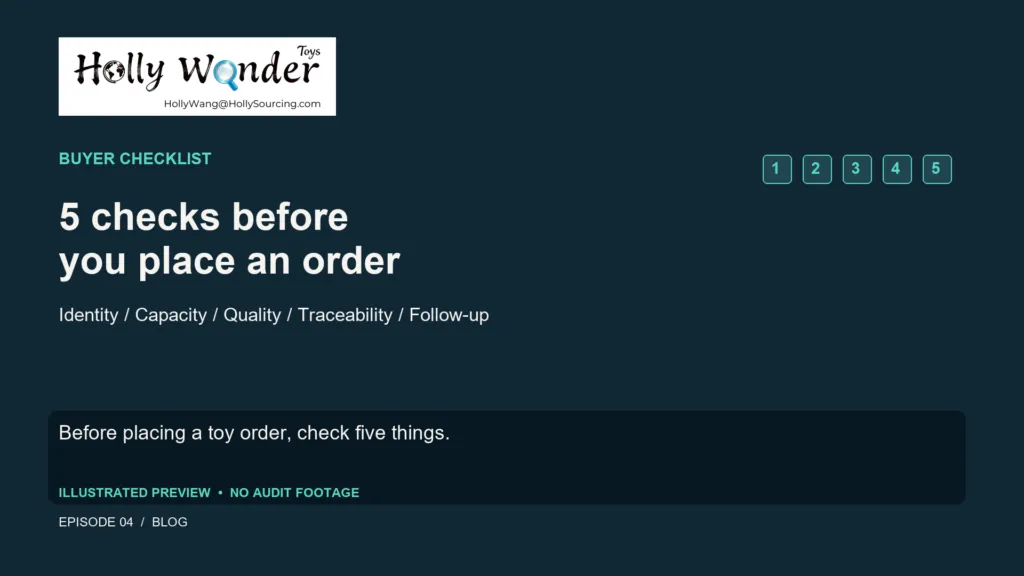
This guide outlines five checks to discuss with a supplier and a
qualified auditor. It does not evaluate or approve any specific factory.
What a Factory Audit Can Tell You
A factory audit examines a manufacturing site and selected systems
against an agreed scope. A capability audit may examine equipment,
staffing, workflow and quality records. A social or environmental
audit has a different scope and requires the appropriate criteria
and expertise. Agree on the purpose before commissioning a visit;
one report should not be assumed to cover every subject.
A visit is also a snapshot. Findings apply to the site, processes,
documents and conditions actually assessed. Buyers should understand
the date, scope, limitations and exclusions of the report before
relying on it.
1. Verify Legal Identity and the Production Site
Match the Paperwork to the Place
Request the supplier’s registered legal name, business registration
details and production address. Compare those details with the
contract party and the site named in the audit. Where the seller
and manufacturer differ, establish each party’s role and who is
responsible for production, quality, communication and corrective action.
A trading company may be a suitable sourcing partner. The important
question is whether the production arrangement is transparent.
Ask which factory will make your specific item, whether more than
one site is involved, and how changes to that arrangement will be
communicated and approved.
Evidence to Request
Ask for registration information, a site address, a process map
and a written statement identifying the manufacturer and subcontracted
processes. A site sign or showroom display alone does not establish
who manufactures the product. Resolve inconsistent names or addresses
before treating the evidence as reliable.
2. Confirm Equipment, Capacity and Subcontracting
Check the Route Your Product Will Follow
Walk through the proposed manufacturing sequence, from receiving
materials to packing finished goods. For a plastic toy, relevant
steps may include molding, decorating, assembly and packing.
An electronic toy may also require board assembly, wiring or
functional checks. Not every site performs every process in-house,
so record where each step occurs.
Review the equipment actually available for the item and discuss
current order loading, staffing, maintenance and likely bottlenecks.
A machine count is not enough to establish available capacity.
Ask how the supplier calculated the proposed output and which
assumptions could affect the delivery date.
Make Outsourced Work Visible
Identify subcontractors, their locations and the processes assigned
to them. Ask how requirements are passed to those sites and how
output is checked before it returns. If the supplier proposes a
different production site after approval, define whether the change
requires additional review. Record estimates as estimates until
supported by relevant evidence.
3. Review How Quality Is Controlled
Follow One Product Through the Controls
Request examples of incoming material checks, in-process controls
and final inspection records for comparable work. Look for clear
acceptance criteria, current work instructions, staff responsibilities
and records of what happened when a check failed. An approved sample
should connect to documented specifications rather than depend only
on someone’s memory.
Choose inspection points that fit the product’s risks. A toy with
batteries, moving parts or small detachable components needs a
different control plan from a simple fabric item. On-site checks
can help assess process discipline, but they do not automatically
establish conformity with all applicable product safety requirements.
Check the Response to Defects
Ask how nonconforming materials are identified and separated,
who authorizes rework, and how reworked goods are checked again.
Where measuring equipment is used, examine its suitability and
calibration or verification records as appropriate. A tidy inspection
desk is useful only if the controls are applied consistently and recorded.
4. Trace Materials, Batches and Product Evidence
Connect Records to the Item You Will Buy
Select an item or production batch and ask the supplier to trace
it back to the relevant material and component records. Then follow
it forward to production and packing records. The purpose is to
understand whether the supplier could identify affected goods if
a material, component or process problem emerged.
Review test reports with the same care. Match the model, photographs,
materials, age grading and other identifying details to the proposed
item. Check the report’s scope, date and issuing laboratory, and ask
how changes to materials, components or design are assessed.
A report for another product is not evidence for yours merely because
both products come from the same factory.
Keep Product Testing Separate from the Factory Audit
A factory audit considers site conditions and systems within its
scope. Product compliance testing evaluates a product against
specified requirements. A shipment inspection examines a defined
lot against an agreed inspection plan. These activities can support
one another, but none should be represented as a universal substitute
for the others.
For the US market,
CPSC Toy Safety Business Guidance
explains the toy safety testing and certification framework and
when CPSC-accepted third-party laboratory testing applies to
children’s products. Ask a qualified laboratory to identify
requirements for the specific toy and intended market. Do not
treat a general factory audit result as a product safety certificate.
5. Record Findings and Verify Corrective Actions
Agree What Happens After the Visit
A useful finding identifies the requirement, the evidence observed
and the gap. Record the risk, responsible owner, target date and
evidence needed for closure. Ask the supplier to address the cause
of a problem as well as the immediate symptom. The agreed response
should be proportional to the issue and the buying decision.
A photograph of a changed workstation may support one action,
but repeated problems may require records, interviews, follow-up
checks or a return visit. Define who verifies closure and whether
any finding prevents order approval. An action marked complete
by the supplier is not the same as independently verified closure.
Frequently Asked Questions
Is a Showroom Visit the Same as a Factory Audit?
No. A showroom can help buyers compare products and discuss options.
It does not establish the conditions at the manufacturing site.
Confirm where production takes place and arrange the appropriate
assessment for that location.
Does a Factory Audit Prove That a Toy Is Compliant?
No. An audit reviews the agreed site and systems. Product-specific
testing, documentation and other applicable obligations require
separate review. Match the evidence to the exact product and
destination market.
Can a Trading Company Work with an Audited Factory?
Yes. Clarify the seller’s role, the manufacturing site and
responsibility for quality and corrective actions. The arrangement
should be transparent and reflected in the order documentation.
How Often Should a Factory Be Audited?
There is no single interval suitable for every buyer. Consider
product risk, customer requirements, changes of site or ownership,
performance history and unresolved findings when deciding whether
a new assessment is needed.
Should Buyers Accept a Report Supplied by the Seller?
Review its authenticity, scope, site details, date and limitations.
Where appropriate, seek confirmation from the issuing organization
through an authorized channel. Do not assume a shared PDF is current
or applicable to your order.
What Should Buyers Do When a Supplier Declines Access?
Clarify the reason and consider whether alternative evidence can
answer the question. Record unresolved gaps. If essential production
or traceability information remains unavailable, reassess the
sourcing decision rather than presenting the supplier as verified.
Plan the Next Supplier Conversation
Start with your product category, destination market, intended
age range, estimated volume and delivery window. Use those details
to decide which evidence to request and what an assessment should cover.
For more context, read our
Chenghai sourcing background
and browse our
toy sourcing articles
.
To discuss your sourcing brief with Holly Wonder Toys,
contact us through our website
or email
hollywang@hollysourcing.com
.
The scope of any sourcing, inspection or audit support should
be agreed separately; this article does not promise an audit
service or verified supplier capability.
Related toy categories
Explore the wholesale ranges that match this guide:
- Kid Toys — the full wholesale kids toy range
- Best Sellers — our current best-selling toy lines
- Early Education — early learning and preschool toys